

HomeWebsites for gardeners and landscapers
Websites for gardeners and landscapers
Websites for gardeners and landscape gardeners
Garden work is seasonal, visual and very local. Maintenance customers want reliability; landscaping clients want to see what you could do with their plot. We design gardening websites that serve both, without one drowning out the other.
- Separate journeys for maintenance and landscaping
- Photo-led project pages that load fast
- Enquiry forms that capture garden size and access

01 / How people search
How people look for a gardener or landscaper
Demand for garden help rises and falls with the seasons. Lawn and hedge enquiries arrive in spring, patio and fencing projects are often planned over winter, and clearance jobs follow storms. A site built around one type of customer misses the others.
Two very different buyers
Someone wanting a fortnightly lawn cut compares reliability and price. Someone planning a full redesign compares ideas and finished work. Each needs a different page and call to action.
Photos without the story
A beautiful patio photo does not tell a homeowner how long it took, what was involved or whether you dealt with drainage and levels. Short project notes do.
Wasted site visits
Without basic details such as garden size, access and whether waste needs removing, you can lose an afternoon quoting for a job that does not suit you.
02 / Example design
Template preview: Fernmoor Gardens & Landscapes
Here is a homepage for Fernmoor Gardens & Landscapes, an invented business we use to demonstrate how a garden firm could present design work and maintenance rounds side by side.
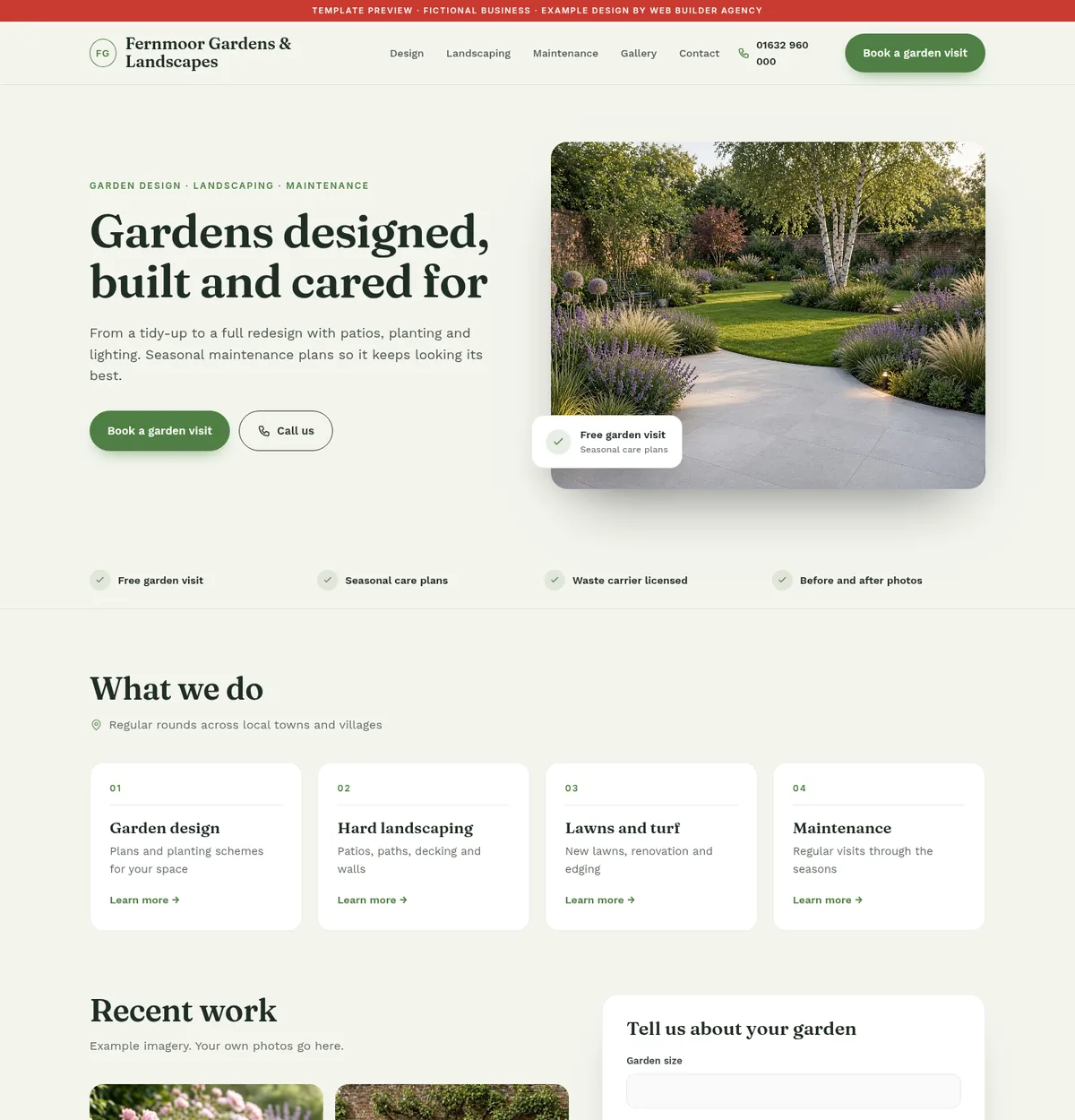
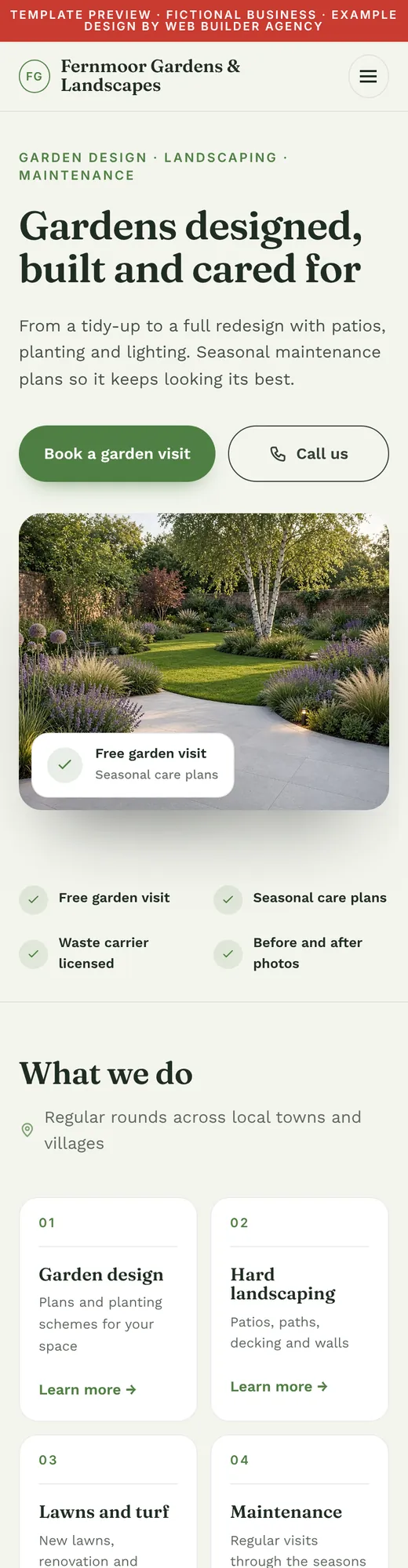
- Garden visit booking above the fold
- Landscaping and maintenance as separate routes
- Project photo grid with short captions
- Photos, reviews and prices are placeholders
03 / Must-have features
Features that work for garden businesses
These match how garden customers decide and how your working year actually runs.
Maintenance round sign-up
A page explaining what regular visits include, how often you come and how to join, with a waiting list when your rounds are full.
Landscaping project pages
Patios, planting schemes, turfing, fencing and garden rooms, each with before and after photos and a few lines on the challenge.
Photo-upload enquiries
Customers send photos, rough dimensions and access notes, so you can triage jobs before travelling.
Seasonal updates
A short note each season on what you are booking now, which keeps the site current and reminds past clients to get in touch.
Design consultation booking
For landscape gardeners who charge for design, a clear explanation of the consultation, what it costs and what the client receives.
Service radius
A simple list or map of the villages and towns on your rounds, so enquiries come from places you actually go.
04 / Trust and compliance
Trust, waste and legal points worth showing
Customers are letting you onto their property and often asking you to take waste away. A few clear statements reassure them that you run things properly.
- In England, if you carry away waste from your own jobs you need to register as a waste carrier with the Environment Agency; carrying other people’s waste or construction waste needs upper-tier registration. Wales, Scotland and Northern Ireland have their own regulators. GOV.UK waste carrier registration
- If you offer tree work, explain that trees protected by a Tree Preservation Order need council consent, and work on trees in a conservation area usually needs six weeks’ notice to the council. GOV.UK tree guidance
- Anyone applying pesticides authorised for professional use needs a recognised certificate. If you offer weed control, say which certificates your team holds. HSE pesticide FAQs
- State your public liability insurance, and only show trade association badges, such as BALI, if you are a member.
- Enquiry forms that collect photos of someone’s home and garden handle personal data under UK GDPR, so we include a privacy notice and keep only what you need.
05 / Local SEO
Local SEO for garden businesses
Your customers are within a set radius of your base, so your Google Business Profile does a lot of the work.
- Set the profile up as a service-area business and choose the primary category that fits your main income, such as Gardener, Landscaper or Landscape designer, with others as secondary categories.
- Upload new photos regularly, especially through spring and summer, and keep them consistent with the project pages on your site.
- Ask every customer for a review in the same way, for example with a link on your invoice. Google does not allow discounts or other rewards in exchange for reviews. Google review policy
- Write service pages around how people describe the job, such as “garden clearance” or “porcelain patio laying”, rather than trade jargon.
See our local SEO service for ongoing help.
06 / Checklist
What a good gardening website includes
A quick reference for planning or reviewing your site.
- Separate pages for maintenance and landscaping
- A maintenance sign-up or waiting list
- Project pages with before and after photos and short notes
- An enquiry form with photo upload, garden size and access questions
- Waste carrier registration and insurance details
- The villages and towns on your rounds
- Seasonal availability, kept up to date
- Recent Google reviews
- Images compressed so galleries stay quick on mobile data
07 / Cost
What a gardening website typically costs
The same three packages as every sector, shaped around a garden business.
Essential, from £1,000
One page for a sole-trader gardener: services, a small gallery, rounds covered and a contact form with photo upload.
Business, from £2,500
A multi-page site with separate maintenance and landscaping sections and a project gallery you can grow.
Bespoke, custom quote
For landscape design studios needing extras such as a design consultation booking flow or a client planting guide area.
Final pricing is agreed in writing before work begins. Optional care plans from £99 a month cover seasonal updates if you would rather not do them yourself.
We design every site from scratch, so a landscaping studio and a one-person maintenance round end up with very different websites. See website design or creative design.
Questions
Gardeners and landscapers: common website questions
Should maintenance and landscaping be on separate pages?
Yes, in most cases. The people are looking for different things, so each page can speak to them directly and use its own call to action: joining a round, or booking a garden visit.
How often should I update my garden website?
A short seasonal update four times a year, plus new project photos when you finish notable jobs, is plenty. It keeps the site accurate and gives search engines fresh, relevant content.
Should I show my waste carrier number?
If you remove garden waste, showing your registration number is a simple way to reassure customers that it will be dealt with legally. They can check it on the Environment Agency’s public register.
Can customers send photos of their garden through the website?
Yes. We add an upload field with sensible size limits, so you can see the space, access and any obstacles before deciding whether to visit.
Will big photo galleries slow my site down?
Not if they are prepared properly. We resize each photo for different screens, use modern formats and load galleries only as visitors scroll.
A better website
starts with a conversation
Book a £99 SEO audit
Let's discuss your next website
Send us your business name, a brief description of what you'd like to achieve, and your preferred budget, and we'll be in touch soon.